Brake pads and rotors: what replacement costs in BC
Real per-axle prices, the tax math, and how to tell if your rotors actually need replacing.
Brake pads and rotors replacement cost in BC typically runs about $350 to $600 per axle before tax, depending on the vehicle and the parts. At our Abbotsford shop, pads and rotors start at $399 per axle installed, and pads alone start at $179 per axle, plus tax. If your rotors still measure within spec, you may only need pads, and we will tell you.
In this article
Most brake bills come down to one question: do the rotors need replacing, or just the pads? That one answer can more than double the price. Here is what brake pads and rotors replacement costs in BC, what pushes it up, and how we decide whether your rotors are actually done.
What brake pads and rotors replacement costs in BC
Brake work is priced per axle: both front wheels, or both rear wheels. Here are our current prices. Every price includes installation.
For comparison, Canadian repair shops and parts sellers that publish their numbers typically list pads and rotors at about $350 to $600 per axle, with a full pad and rotor job across both axles often landing between $400 and $900. Shop labour rates they quote run about $100 to $180 an hour. Those are typical market ranges, not our prices, but they help you judge a quote.
What you actually pay, with tax
In BC, brake work carries 5% GST and 7% PST. Here is how our starting prices work out:
| Job | Before tax | GST 5% | PST 7% | Total |
|---|---|---|---|---|
| Pads and rotors, one axle | $399.00 | $19.95 | $27.93 | $446.88 |
| Front pads and rotors + rear pads only | $578.00 | $28.90 | $40.46 | $647.36 |
| Pads and rotors, both axles | $798.00 | $39.90 | $55.86 | $893.76 |
These are starting prices before any shop-supply or hazmat charge. Your exact price depends on the vehicle, and you approve it before we start.
Why the front and rear axles cost differently
On most cars and SUVs the front brakes do most of the stopping, because weight shifts forward when you brake. So front pads and rotors usually wear out first, and front rotors are often bigger and thicker than the rears. That is why it is common to need pads and rotors up front and only pads in the back, or nothing in the back at all.
The rear can bring its own costs, though:
- Electronic parking brakes. Many newer vehicles need a scan tool to retract the rear calipers before the pads can come out. It adds time.
- Drum-in-hat parking brakes. Some SUVs and trucks have a small parking brake drum inside the rear rotor, with its own shoes and hardware.
- Rear rotors that rust. Rear brakes do less work, so they stay cooler and do not scrub themselves clean. On cars that sit or do short trips, rear rotors often rust out before they wear out.
Because we quote per axle, you only pay for the end of the car that needs it.
What pushes the price up
"From $399" is the starting point for a typical car. These are the things that move a brake rotor replacement cost higher:
- Vehicle size. Trucks, larger SUVs and vans use bigger, heavier rotors and pads, and the parts cost more.
- European and performance vehicles. Larger or two-piece rotors, wear sensors that must be replaced with the pads, and extra steps add up.
- Parts grade. Dealer (OEM) parts usually cost more than quality aftermarket parts. We install quality aftermarket pads and rotors, which is part of how we keep the price down.
- Calipers. A seized caliper or a sticking slide pin wears one rotor much faster than the other and can make new parts fail early. If the calipers need work, that becomes a full brake service, which we quote after we inspect it.
- Rust and seized hardware. Years of wet roads and winter salt can weld a rotor to the hub. It takes longer to get off.
Bigger vehicles cost more, and we tell you that before we start, not after.
Signs your rotors are worn
Pad wear has its own warnings, covered in our guide on when to replace brake pads. Rotors tell you they are done in different ways:
- A pulsing brake pedal or a shaking steering wheel when you brake. People call these "warped rotors". Usually the rotor has worn unevenly or picked up uneven pad deposits, so its thickness varies around the face. You feel it most when slowing from highway speed.
- Deep grooves or scoring. Light lines are normal. Grooves you can catch with a fingernail usually mean metal-on-metal contact or grit trapped in the pad.
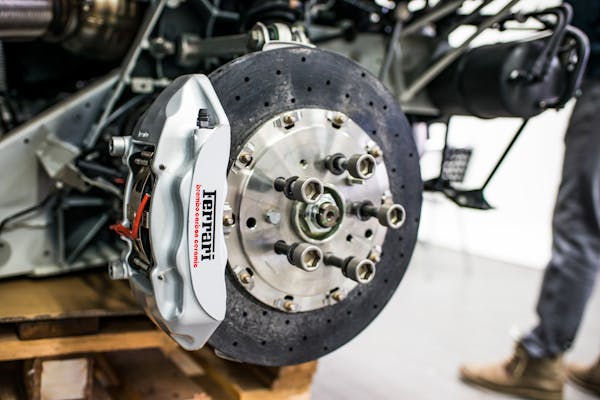
- A raised lip on the outer edge. The pad only touches the braking surface, so as the rotor wears thinner, a ridge forms at the edge. A tall lip means a lot of metal is gone.
- Blue or dark spots. These are heat marks from hard braking or a dragging caliper. Overheated spots are harder than the rest of the rotor and can cause pulsing and noise.
- Below minimum thickness. Every rotor has a minimum thickness, often stamped on it as "MIN TH". Below that, it cannot soak up heat properly and has to be replaced.
- Rust that does not clear, or cracks. Surface rust after a wet night is normal. Pitted rust on the braking surface, or any crack, is not.
That usually points to a sticking caliper or a contaminated pad, not just worn rotors. Have it checked soon. If the car pulls when you are not braking, it may be alignment instead: see how often you need a wheel alignment.
Resurface or replace rotors?
Resurfacing (also called machining or turning) shaves a thin layer off both faces of the rotor to make them flat again. Some shops still offer it. We do not, and here is why: it removes metal, so a resurfaced rotor is thinner, holds less heat, and tends to pulse again sooner. Many modern rotors are made thin from the factory to save weight, so there is little metal left to cut, and the labour to resurface can cost close to a new rotor anyway.
So we keep it simple. We measure the rotors, and you get one of two answers:
| What we find | Usual answer |
|---|---|
| Smooth or lightly marked, well above minimum thickness | Pads only. Rotors stay. |
| Pulsing pedal, uneven wear or a tall lip on the edge | Replace the rotors. |
| Close to or below minimum thickness | Replace the rotors. |
| Deep grooves, hot spots, cracks or heavy rust pitting | Replace the rotors. |
A new rotor starts at full thickness, so it handles heat better and lasts longer than a cut one. If your rotors are still good, we tell you, and you only pay for pads.
Rotors are always done in pairs on the same axle, so both sides brake evenly. They do not need to be done on both axles at once.
Fraser Valley driving and your rotors
Driving around Abbotsford and Mission is tough on rotors in a few ways:
- Months of rain. Bare rotors flash-rust overnight. That orange film should clear in the first few stops. On a car that sits for a week at a time, the rust can eat into the braking surface and leave a rough ring that pads never clean off.
- Long downhills. Coming down Sumas Mountain, or the long grades on the Coquihalla, puts a lot of heat into the front rotors. Riding the brakes the whole way down is how rotors get blue spots and a pulsing pedal. A lower gear lets the engine do some of the work.
- Winter grit and salt. It packs into the caliper slides and the rotor hub, which leads to sticking calipers and seized rotors.
If you have a winter highway trip coming up and the brakes pulse or grind, get them looked at before you go. ICBC has more road safety tips for winter driving in BC.
Pads and rotors at Kingdom Auto & Detail
Here is how a brake job goes at our shop on 4th Ave in Abbotsford. Drivers from Mission and the rest of the Fraser Valley are welcome too.
- Call or book. Call (778) 666-6011 with your year, make and model. Brakes are often a same-day job, so ask if we can take you in today.
- We measure. Pad thickness, rotor thickness against the minimum, and the calipers. We only replace what is worn.
- You see what we see. We send a video inspection to your phone, so you can see the rotors yourself.
- You approve the price. You get the estimate before any work starts. No surprise line items at pickup.
Our work comes with a parts warranty of 3 to 12 months, depending on the part. For bigger jobs, a free courtesy car is available, subject to availability, when you book at least 2 days ahead and the job is over $350 and needs 3 or more hours in the shop. Full details are on our brake service page.
- Kingdom prices: pads and rotors from $399 per axle, pads only from $179 per axle, brake fluid flush $99.99, all plus tax.
- Typical Canadian shop pricing for pads and rotors is about $350 to $600 per axle. Trucks, SUVs and European cars sit at the top.
- Rotors are done when they are below minimum thickness, deeply grooved, cracked, or causing a pulsing pedal.
- We do not resurface rotors. If they measure within spec you only pay for pads; if they are worn, we replace them with new rotors.
- Front and rear axles are priced separately, and often only one needs rotors. Call (778) 666-6011.