How often should you change your oil? Plus a simple maintenance schedule
A straight answer in kilometres, the conditions that shorten it, and a one-page schedule for everything else your car needs.
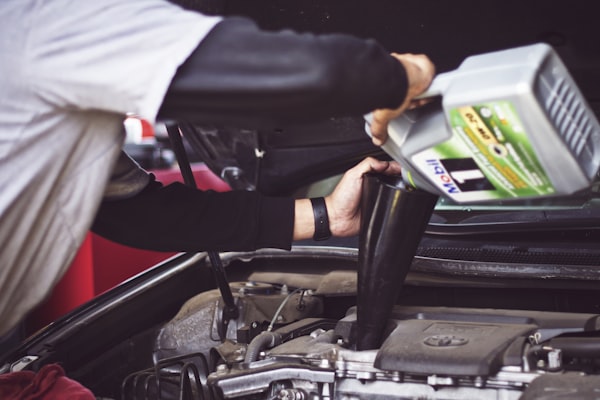
For most cars on full synthetic oil, change the oil every 8,000 to 16,000 km or every 6 to 12 months, whichever comes first. Your owner's manual gives the exact number for your engine. If you mostly drive short trips, sit in stop-and-go traffic, tow, or drive in cold, wet weather, use the severe service schedule, which is usually closer to 5,000 to 8,000 km or 6 months. At our Abbotsford shop, a full synthetic oil change is $120 + tax.
In this article
"Every 5,000 km" and "every 3 months" are rules from older engines and older oil. Modern engines on full synthetic oil can usually go further. But how often to change oil really depends on two things: what your owner's manual says, and how you actually drive. Here is how to work out your number, plus a simple schedule for the rest of the car.
How often to change oil: the quick answer
Find the row that sounds most like your driving. These are typical ranges, not rules. If your manual says something different, the manual wins.
| Your car and driving | Typical oil change interval |
|---|---|
| Newer car, full synthetic, mostly steady highway driving | 10,000 to 16,000 km or 12 months |
| Newer car, full synthetic, mixed town and highway | 8,000 to 12,000 km or 6 to 12 months |
| Short trips, stop-and-go traffic, towing, cold winters | 5,000 to 8,000 km or 6 months |
| Older car, conventional oil, or an engine that uses oil | 5,000 to 8,000 km or 6 months |
| Car that sits most of the time | At least once a year, even on very low km |
How many km between oil changes?
Most owner's manuals for cars from the last 10 to 15 years list two schedules: a normal one and a severe one. The normal schedule is often somewhere from 8,000 to 16,000 km. The severe schedule is usually about half of that.
Here is the part most people miss: by the carmaker's own definitions, a lot of everyday driving counts as severe. So if you are not sure which one fits, the severe schedule is the safer bet. An extra oil change costs far less than an engine.
Changing the oil every 5,000 km will not hurt anything. It may just be more often than your car needs. Going well past the interval is where the risk is: oil that has broken down protects the engine less, and sludge can start to build up in the parts you cannot see.
Synthetic oil change interval
Full synthetic oil resists heat and breakdown better than conventional oil and flows better on a cold start. That is why manuals that call for synthetic usually allow longer intervals, and many newer engines require it. Every oil change we do uses full synthetic.
Can synthetic go 16,000 km (about 10,000 miles)? On some engines, under normal driving, yes, if the manual allows it. It is not a free pass, though. Synthetic oil still collects fuel, moisture and dirt, and the filter still fills up. If your driving is on the severe list below, shorten the interval no matter what oil you use.
What the oil life monitor actually tells you
Many newer cars show oil life as a percentage, or pop up a "maintenance required" message. Most of these systems do not test the oil itself. They calculate it from things like engine revs, engine temperature, trip length and time since the last change. Short, cold trips make the number drop faster, which is the system doing its job.
- Trust it, but reset it. The monitor only works if it is reset after each oil change. We reset it for you and tell you the km when the next one is due.
- 15% or less: book the oil change in the next few weeks.
- 0% or "service now": book it now. It is not an emergency, but do not leave it for months.
The oil life reminder is not the same as the red oil pressure warning. The red light means the engine is low on oil or is not getting oil pressure. Pull over safely, turn the engine off and check the level. Driving on with that light on can ruin an engine within minutes.
Severe driving conditions, and why most Fraser Valley driving counts
Severe service sounds like off-roading. It usually is not. Most manuals list conditions like these:
- Lots of short trips, especially under about 10 km, where the engine never fully warms up. Moisture and unburned fuel stay in the oil instead of burning off.
- Cold, wet weather. A Fraser Valley winter of damp mornings and quick runs to school, work and the store is exactly this.
- Stop-and-go traffic and long idling. Highway 1 at rush hour toward Langley and Surrey counts.
- Towing or heavy loads, such as pulling a trailer or camper up the Coquihalla, or hauling on hills like Sumas Mountain.
- Dusty or gravel roads, which also clog the engine air filter faster.
If two or more of those sound like your week, use the severe schedule. Turbocharged engines are often harder on oil as well, so follow the manual closely if you have one.
Is once a year enough?
If you drive very little, an oil change once a year is usually the minimum, and many manuals set a time limit of 6 or 12 months whatever the km. Oil absorbs moisture and breaks down even when the car sits, and a car that only does short trips is the hardest on its oil. If yours sits most of the week and then does short hops, every 6 months is the better choice.
A simple car maintenance schedule
Oil is the most frequent job, but not the only one. This car maintenance schedule shows typical intervals for most cars and light trucks. They are general guidance, not rules: your owner's manual has the exact schedule for your vehicle, and we follow it when we service your car.
| Item | Typical interval | Notes |
|---|---|---|
| Engine oil and filter | 8,000 to 16,000 km or 6 to 12 months | Severe service: about 5,000 to 8,000 km or 6 months. |
| Tire rotation | Every 8,000 to 10,000 km | Easy to do at every oil change. |
| Brake inspection | Every 10,000 to 20,000 km, or once a year | Pads, rotors and fluid. Sooner if you hear a squeal. |
| Engine air filter | Every 20,000 to 50,000 km | Sooner on dusty or gravel roads. |
| Cabin air filter | Every 20,000 to 30,000 km, or once a year | A clogged one weakens heat, defrost and AC airflow. |
| Wiper blades | Every 6 to 12 months | Before the rainy season is a good habit here. |
| Battery test | Once a year after it is 3 years old | Cold mornings expose a weak battery. |
| Brake fluid | Every 2 to 3 years | Brake fluid absorbs moisture over time. |
| Transmission fluid | Every 50,000 to 100,000 km | Some manuals say "lifetime". Severe service shortens it. |
| Coolant | Every 100,000 to 160,000 km, or 5 years and up | Depends on the coolant type. Check the manual. |
| Spark plugs | Every 100,000 to 160,000 km | Older engines and plug types can be much sooner. |
| Wheel alignment check | Once a year | And after new tires or a hard pothole hit. |
You do not have to track all of that alone. Our Basic Service bundles an oil change, a tire rotation, a brake inspection and a multi-point check. Our Full Service covers the oil change, all filters, fluid top-ups or flushes as needed, a tire rotation and a full inspection with a video report sent to you, so you see what we see. For the bigger fluid jobs, see what a transmission fluid change costs.
Car maintenance checklist between services
A five-minute check once a month catches most problems early:
- Check the oil level on the dipstick with the engine off, on level ground. Top up if it is near the low mark. If you add oil often, tell us: the engine may be leaking or burning it.
- Look at the oil. Brown to black is normal. Milky or foamy oil can point to coolant getting in, and needs a look soon.
- Check tire pressure when the tires are cold, against the sticker in the driver's door jamb.
- Look under the car where you park for fresh drips.
- Test the lights and wipers, and top up washer fluid with a winter mix from fall onward.
- Listen when you brake. A steady squeal is often the pad wear indicator. Our guide on when to replace brake pads explains the sounds.
Two more good habits: look up your vehicle on Transport Canada's recalls site once a year, and before a winter trip over the Coquihalla, check road conditions on DriveBC. Natural Resources Canada also has tips on how regular maintenance and tire pressure affect fuel use.
What an oil change costs at Kingdom
One straight price, with what it includes:
A worked example: a $120 oil change plus 5% GST ($6.00) and 7% PST ($8.40) is $134.40. Most cars take 5 litres or less. Bigger engines that hold more oil pay for the extra litres, and we tell you that before we start, not after.
Same-day oil changes in Abbotsford
Oil changes are one of the jobs we can often do the same day. Call (778) 666-6011 with your year, make and model, and we will tell you when we can take you in. Here is what you get each time:
- Full synthetic oil and a new filter, matched to your engine.
- A basic inspection with every oil change. If we spot something, we show you.
- Your oil life monitor reset, and the next due km noted for you.
- A price before any extra work. Nothing else gets done unless you approve the estimate first.
We are an independent shop on 4 Ave in Abbotsford, and we work on any make and model. Drivers from Abbotsford, Mission and around the Fraser Valley are welcome. See the full details on our oil change service page.
- Typical full synthetic interval: 8,000 to 16,000 km or 6 to 12 months. Your owner's manual sets the real number.
- Short trips, stop-and-go traffic, towing and cold weather count as severe service. Plan on about 5,000 to 8,000 km.
- Change the oil at least once a year even if you barely drive. Oil ages in the engine.
- Check the dipstick once a month. Low oil does more damage than old oil.
- At Kingdom: oil change $120 + tax with full synthetic oil (up to 5 L), a filter and a basic inspection, often the same day. Call (778) 666-6011.